

Falling for a trick a real estate agent plays on you can cause all sorts of emotions.
Guilt, shame, anger, frustration…
And betrayal by the person you trusted to help you buy or sell a home.
But your emotions aren’t the only thing at risk.
Being deceived can cost you a whole lot more than you think.
The problem?
It’s not easy to spot the games that some agents will play on you.
This holds true whether you’re working with an agent or still searching for one.
But this is where I can help…
I’ve been in the trenches and can spot these dubious games from a mile away.
Here are the top seven real estate agent tricks and games to watch for.
1. Convince homeowners to sell off market
This is generally geared toward sellers who have a house that could use some updating.
Why?
Because it relies on the agent suggesting that the home’s condition will significantly hinder buyers from making an offer.
The agent’s goal is to put the seller in a state of worry so that they’re more likely to fall prey to their plot.
Then comes the pitch.
“I have a buyer who may be interested in your home.”
That buyer is a real estate investor.
But this isn’t a typical agent-buyer relationship.
It’s a long-term partnership that makes both the agent and the investor a boatload of money.
How?
The agent turns one commission into three by representing the:
- Seller in the off-market sale
- Investor in the off-market sale
- Investor after the property is updated and listed on the market.
The triple commission is how investors lure in the shady agents.
Here’s one example of many emails and texts I used to get before founding SoldNest…
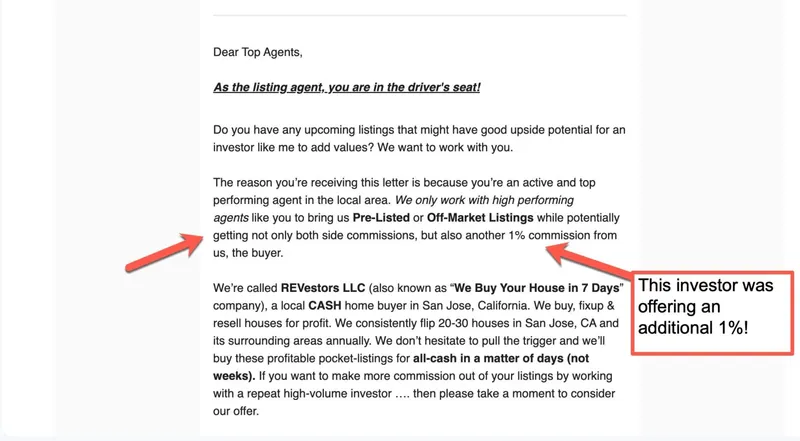
The result of sellers falling for this is letting the investor make a massive profit that should have been theirs.
Which means the final price is well below market value.
In most cases, at least ~20% lower than what they could have got by putting their house on the MLS (sometimes ~30-40%).
This is why you need to be aware of the intent behind an off-market buyer when selling a house for cash.
If an agent attempts to orchestrate this on you, don’t work with them.
They’re trying to convince you to transfer money from your pocket into theirs.
2. Overpromise on the listing price
Most sellers would love for a buyer to pay a ridiculously high price for their home.
Some agents use this to their advantage.
How?
By exaggerating how much they can sell a house for.
Any prospective listing agent will provide you with their opinion of what they think your home should be listed at.
They may present this price estimate to you during your initial agent consultation, or a day or two after.
But spotting the agent’s price illusion is tricky.
That’s because some agents are experts at convincing a seller that their house is worth more than it is.
Why would they do this?
To get you to sign the exclusive agent listing agreement.
They know that your home will sit on the market and you’ll need to reduce the price.
But…
They’re okay with this because they have you locked into a contract.
Which means they still get a commission as long as your house eventually sells.
The issue is that homes lingering on the market for too long often sell for less than their potential value had they been priced correctly from the outset.
How can you avoid this?
First, never hire an agent solely based on their recommended listing price.
Second, keep your opinion about your home’s value to yourself.
You’re less likely to be duped if you don’t give an agent a number to work with.
This is why your price expectations are one of the key things you should not say to a real estate agent when selling.
3. Lie about having an interested buyer
“I have buyers looking for a home just like yours.”
That’s the way this starts.
You’ll usually see some variation of this verbiage on mailers or on an agent’s website.
And you might hear this when receiving a cold call or a knock on your door.
The agent’s goal?
To exacerbate the anxiety that some sellers feel about whether a buyer will be interested in their home.
So they leverage this to secure a preliminary meeting.
All while knowing that there isn’t a real buyer.
The game continues when the agent shifts the narrative to why the seller should hire them.
They’re discussing the home’s value, their marketing plan, etc.
Then one of two scenarios will usually happen…
The seller forgets about the “buyer” and hires the agent.
Or…
The agent says the seller needs to sign an agreement in order for the “buyer” to view the home (which isn’t true).
Alarm bells should be ringing if this happens to you.
Because there’s only one of two things happening…
Either the agent is lying…
Or there really is a buyer and the agent wants to represent both parties to double their commission.
4. Persuade a seller to accept their buyer’s offer
What makes the crooked real estate agents pull out their top covert maneuvers?
An opportunity to earn two commissions from representing both the seller and the buyer in the same sale.
This is known as a dual agency transaction, creating a powerful incentive for agents.
That’s why pitching a dual agent scenario is one of the deceptive games agents play with sellers.
The strategy starts when a listing agent knows that their seller is fearful of buyers not being interested in their house.
This is the key ingredient for this to work.
Why?
Because the more fearful a seller is, the less likely they are to be concerned about working with a dual agent.
This makes it much easier for an agent to persuade a seller to accept their buyer’s offer.
Here is what you want to watch out for if you’re presented with this scenario:
- Did the agent initially disclose that the offer was from their buyer, mention it later, or fail to mention it at all? Consider it a major red flag if they didn’t initially disclose it.
- Pay attention to the “used car salesmen pitch.” This is usually a telling sign that the agent is prioritizing their interests over yours.
- Did the agent agree to eliminate the commission for representing the buyer? If not, the chances of them risking their integrity drastically increase.
You should seriously consider firing your Realtor if you’re in a shady scenario where they want to represent both sides.
The unethical agents will take advantage of every opportunity to earn more money from one sale.
And that almost always results in a lower price for the seller.
This is why you need to be aware of a listing agent wanting to morph into a dual agent.
It’s one of the warning signs of a bad Realtor.
This is one reason why we analyze an agent’s transactions before matching them with a seller.
We never recommend an agent who has represented both sides in the same sale more frequently than the average agent.
Because these are the agents who have a history of lacking integrity.
5. Withhold an offer from a seller
A listing agent is obligated to present every offer to their client.
The important words there are “obligated to.”
Because failing to present an offer to a seller is unequivocally unethical.
Why would an agent withhold an offer?
To ensure that another offer, which financially benefits them, faces no competition.
This trick usually indicates one of two scenarios:
- The agent has received an offer from their own buyer.
- Another agent on the seller’s team is submitting an offer.
Here’s the problem…
A homebuyer dramatically gains leverage when they aren’t facing competition.
Which means the seller is missing out on a golden opportunity to negotiate the best deal.
But this is extremely hard to exploit.
That’s because buyer’s agents typically submit offers to the listing agent via email or a third-party platform.
Neither of which are accessible to sellers.
The deceitful agents are experts at taking advantage of this.
They mislead a buyer’s agent into believing that the seller considered their client’s offer but ultimately chose another.
And the seller is never aware.
Here are three strategies to help you avoid this:
- Ensure your agent does not have a history of representing both the seller and buyer in the same transaction.
- Right from the start, clearly communicate your expectations about transparency and insist on being informed about all offers.
- Include a clause in your agent agreement that requires them to present all offers in writing as soon as they receive them.
These measures will increase your chances of being informed about every buyer’s offer.
And help you dodge a situation where you could unknowingly miss out on tens of thousands of dollars.
I’ve experienced scenarios like this firsthand.
Including this one…
Example of a listing agent hiding a buyer’s offer
Here’s what it looked like when I ran into this in real life.
A buyer I was helping submitted a clean, non-contingent offer on a home.
I called the listing agent and he told me there were “other offers.”
The next morning I followed up to confirm whether those offers had been presented to the seller.
And he told me they hadn’t been presented yet.
So we submitted our offer at $2,725,000 with a same-day expiration.
That night he texted that the seller would decide the next day, so we extended our deadline.
The next day he texted that the seller accepted another offer that was “superior in price.”
When the home closed, it sold for $2,730,000, only $5,000 higher than what we offered.
And my buyers were willing to pay more.
That’s the part sellers never see.
They’re told they received a “great” offer, and they move on, not realizing they left money on the table.
The way this played out is exactly how this game works.
6. Lie about offers
A real estate agent who lies about an offer does so to instill FOMO (fear of missing out).
Either the buyer’s or seller’s Realtor might play this game.
Here’s how this typically unfolds…
The buyer’s agent strongly senses that the buyer is very interested in the house.
Then, they’ll promptly contact the agent selling the house.
The goal for the buyer’s agent is to gather as much information about the home as possible.
And that includes determining whether the listing agent has any offers in hand.
This trick becomes official when the buyer’s agent falsely tells the buyer that there are other offers, despite the listing agent confirming that there are none.
The buyer is trusting that their agent is honest and will help guide their offer strategy.
But the complete opposite is happening.
It’s a full-court press on the buyer’s emotions, exploiting their desire to own the home.
This is why you should be wary of a pushy conversation from your buyer’s agent about the seller receiving other offers.
It’s entirely possible for the seller to have another offer (or even multiple offers).
But a high-pressure tactic is usually a key indicator that your agent is exploiting FOMO to manipulate you.
This is how buyers end up offering a price much higher than what the seller would have accepted.
Although sometimes this occurs because the listing agent falsely tells the buyer’s agent that there are other offers, even when there are none.
How can you protect yourself?
Request that your buyer’s agent obtain the listing agent’s response about offers via email.
This will require both agents to commit their statements to a written record.
7. Conceal the pitfalls of lower commission
Saving money on agent fees can be very appealing when selling or buying a house.
Some discounted real estate agents take advantage of this.
How?
By not disclosing the downsides of paying a lower commission.
Of course, agents who rely on a low-fee business model aren’t going to come right out and tell you the drawbacks.
But they should.
Here’s why…
Agents who charge discounted fees typically run a high-volume business or are struggling.
Not knowing this before hiring a low-commission agent can be costly.
Why?
Because the money you think you’re saving on agent commissions can be far less than what you’ll lose in your sale price.
A high-volume agent does not have the capacity to put in the effort you need them to.
They’re too busy with other clients.
This can easily lead to leaving money on the table if you’re selling a home — or overpaying if you’re buying.
And the same can happen when working with a low-cost agent who is inexperienced or struggling.
They’re not as actively involved in your local market as you need them to be.
Here’s how you can avoid this:
- Confirm how many clients a prospective agent is working with and their number of recent transactions.
- Make sure you can cancel your agent agreement at any time, without owing any commissions.
These can’t guarantee that your agent has the expertise you need or will put in maximum effort.
But they can increase your chances of working with an agent who can give you both.
The bottom line
The real estate agents who are most likely to play tricks on you are the agents who do not possess the right qualifications.
This is why some buyers and sellers end up falling victim to one of these games.
They don’t do the proper vetting ahead of time.
An agent who has the right qualifications increases the likelihood that you’ll work with someone who won’t try to deceive you.
If you’re selling, our no-cost (and no-obligation) service can help you with this.
We use strict criteria to vet top agents in your area.
You can learn more by exploring our agent screening process for sellers.