
Real estate agent commission is usually one of the first costs people think about when buying or selling a home.
But what they don’t realize is how much an agent charges doesn’t tell you everything you need to know.
Does the commission rate matter?
Of course.
But a lower rate doesn’t necessarily mean you’ll save more money.
You also need to consider what the agent is providing for that fee and how it compares to what another agent is charging.
And with the recent changes to how real estate commissions work, who pays an agent isn’t always as straightforward as it used to be.
Understanding the costs, what they cover, and how agents get paid can help you compare your options and know what you’re actually paying for.
How much is real estate agent commission?
There isn’t one standard commission rate that real estate agents charge.
Based on nationwide commission data from SoldNest referral transactions in 2026, the average listing agent commission was 2.83% of the sale price –– and the average buyer’s agent commission was 2.68%.
The commission rates differed by state and sale price.
Here’s what the listing-side averages looked like in our data:
- Under $300,000: 3.02%
- $300,000 – $499,999: 2.95%
- $500,000 – $799,999: 2.57%
- $800,000 and up: 2.69%
Higher-priced homes tended to have slightly lower commission rates.
Using the overall averages of 2.83% for the listing agent and 2.68% for the buyer’s agent, here’s what those commissions would equal at different sale prices:
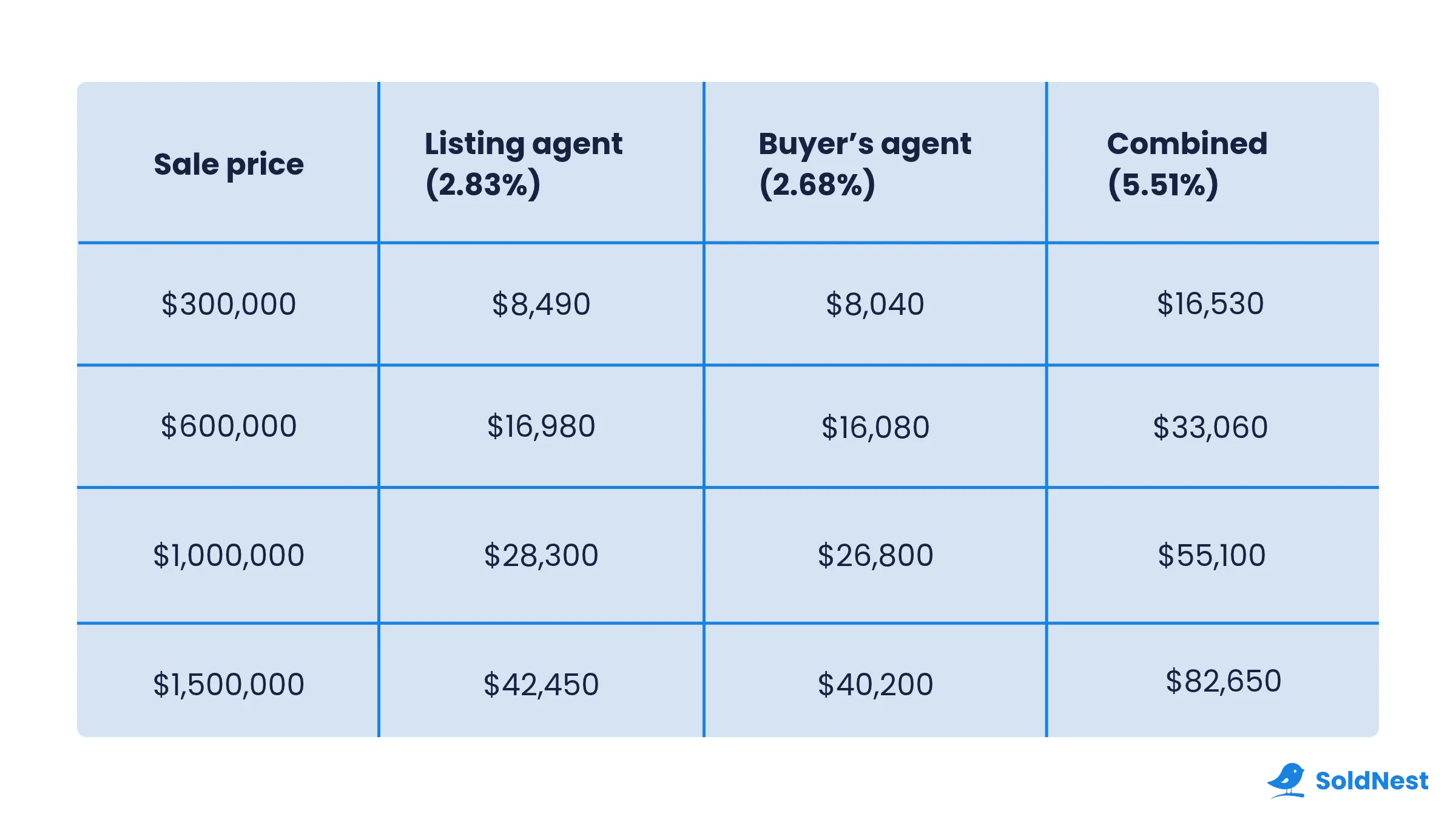
Most real estate agents calculate their fee as a percentage of the final sale price.
But some charge a flat fee or use another pricing structure instead.
How much does an agent make from the commission?
Most real estate agents share a portion of their commission with the brokerage they’re affiliated with.
How much the agent keeps depends on their compensation agreement with the brokerage.
For example, a 2.5% listing commission on a $600,000 home would equal $15,000.
If the agent keeps 70% under their brokerage agreement, their share would be $10,500 before taxes and business expenses.
An agent’s expenses can include marketing, technology, insurance, association dues, and other costs of running their business.
The National Association of Realtors reports that Realtors spend thousands of dollars a year to run their business.
So the commission paid on a transaction can be considerably more than what the individual agent actually takes home.
Who pays real estate agent fees?
Who pays agent fees depends on whether you’re talking about the listing agent or the buyer’s agent.
Here’s how each side works.
Who pays the listing agent?
The seller is responsible for paying the listing agent’s commission.
That amount is agreed to before the home is listed and included in the listing agreement between the seller and the agent’s brokerage.
Once the sale closes, the fee is paid from the seller’s proceeds as part of their closing costs.
Who pays the buyer’s agent?
The buyer agrees to their agent’s compensation in a written buyer agreement.
But that doesn’t mean the buyer pays their agent’s fee.
Depending on the transaction, the buyer’s agent can be paid by the buyer, the seller, or a combination of these.
The buyer could be responsible for the difference if the amount paid by the seller doesn’t cover what the buyer agreed to.
How real estate commission rules have changed
The way real estate agent commissions work changed on August 17, 2024.
Those new rules came from a settlement involving the National Association of Realtors.
They affected how buyers agree to compensate their agents and how buyer-agent compensation can be offered.
Here’s what changed.
Buyers sign an agreement with their agent
Many buyers used to work with a real estate agent without signing a formal agreement.
It wasn’t uncommon to tour homes with an agent before putting anything in writing.
That changed under the new rules.
Buyers now need to sign a written agreement before an agent who participates in an MLS takes them to see a home.
The agreement establishes the services the agent will provide and how much the agent will be compensated.
That compensation is negotiable and must be clearly defined in the agreement.
Buyers can still visit an open house on their own without signing anything.
Buyer-agent compensation is no longer offered through the MLS
The amount of commission being offered to a buyer’s agent can no longer be included in an MLS listing.
Previously, a listing broker could display the commission percentage (or fee) in the MLS.
That information now has to be communicated outside the MLS.
But removing that compensation from the MLS didn’t eliminate the ability for a seller to pay a buyer’s agent.
Buyers can negotiate agent compensation in their offer
A buyer can now ask the seller to pay some or all of their agent’s commission as part of their offer.
That request states the amount or percentage the buyer is asking the seller to pay.
The seller can agree to the request, reject it, or negotiate a different amount.
If both sides agree, the seller-paid compensation becomes part of the purchase agreement.
What affects real estate commission rates?
There are several reasons why commission rates can vary from one agent to another.
Here are some of the factors that can influence what an agent charges.
Home value: The commission an agent quotes can change depending on the expected sale price. The time and work involved in a transaction don’t necessarily increase or decrease with the price of the home, and agents can value that time and work differently when setting their rate.
Local market: An agent may be more willing to negotiate their fee in a market where they’re competing with a lot of other agents. In rural or less populated areas with fewer agents, there may be less competitive pressure to lower rates.
Services included: Not every agent includes the same services in their commission. One might pay for professional photography, staging, and other marketing expenses, while another may charge separately for some of them.
Complexity of the sale: A property that needs extensive preparation, specialized marketing, or has other complications can require more time and attention. One agent may factor that additional work into their commission more than another.
Agent and brokerage pricing: Not all agents have the same pricing structure. Some have more flexibility to negotiate their commission, while others may work within fee structures or minimums established by their brokerage.
What does an agent’s commission pay for?
The commission you pay isn’t just for putting your home on the MLS or unlocking a door to tour a property.
Much of what you’re paying for is the work and expertise that goes into getting the transaction closed.
What that involves depends on whether the agent represents the seller or the buyer.
What a listing agent’s commission covers
Pricing strategy: Your commission covers more than just an agent pulling comps. Their expertise should come into play when deciding which properties are actually relevant, accounting for differences that affect value, and using that information to recommend the right list price.
Preparing your home for sale: Not every repair or improvement is worth making before you sell. Your agent can help you decide what could make a difference, what probably won’t, and where it makes sense to spend your money.
Marketing your listing: Your agent uses photography, the listing description, online marketing, open houses, and other methods to tell your home’s story, reach the right buyers, and generate interest.
Evaluating and negotiating an offer: Your agent helps you weigh the price a buyer offers against their financial strength, contingencies, timeline, appraisal risk, and other terms before negotiating on your behalf.
Managing the transaction: An accepted offer still has to make it to closing. Your agent keeps the transaction moving through inspections, the appraisal, deadlines, disclosures, and any issues or negotiations that come up along the way.
What a buyer’s agent’s commission covers
Understanding the local market: Your agent helps you understand what homes are actually worth and what you can realistically buy with your budget. That includes knowing how recent sales, current inventory, and competition can affect the price you may need to pay.
Finding and evaluating homes: Browsing properties online is the easy part. Your agent can help you identify homes worth considering, arrange showings, and point out potential concerns or other factors that could affect your decision.
Preparing a competitive offer: A competitive offer isn’t always the one with the highest price. Your agent considers comparable sales, competition for the property, your financing, contingencies, timeline, and other terms when helping you decide how much to offer and how to structure it.
Negotiating the purchase: Negotiations can continue well beyond the initial offer. Your agent represents you when negotiating the price and terms, as well as any credits, repairs, or other issues that come up before closing.
Managing the transaction through closing: Accepting an offer is only the beginning. Your agent helps keep inspections, the appraisal, financing, contingencies, escrow, and other deadlines on track while addressing problems that could put the purchase at risk.
How to compare commission rates
Comparing commission rates can help you get the service you need at the right price.
Here’s how to compare fees between different real estate agents.
1. Understand exactly what you’re agreeing to pay
The commission rate an agent quotes doesn’t always tell you what you’ll actually pay.
If you’re selling, check the listing agreement for the percentage or fee you’ve agreed to pay your agent.
If you’re buying, know the compensation you’ve agreed to in your buyer agreement and how much you could be responsible for if the seller doesn’t cover the full amount.
Whether you’re buying or selling, also check for:
- Cancellation fees if you end the agreement early
- Additional brokerage or transaction fees charged on top of the commission.
2. Confirm what services each agent includes
The same service offered by two different agents can look very different in practice.
For example, two listing agents might say photography is included.
But one may hire a professional photographer, while the other plans to take the photos themselves.
An agent might also say they provide staging without making it clear that the seller will pay for it at closing.
The same applies to buyers.
One buyer’s agent may work with you directly throughout the transaction.
With another, you might work with different team members for showings, offers, or other parts of the process.
So don’t just ask what’s included.
Find out what you’re actually getting, who will provide it, and what you’ll have to pay for separately.
3. Weigh each agent’s cost against what they offer
Now put each agent’s commission and services side-by-side to see where they differ.
Let’s say one listing agent quotes 2% on an estimated $600,000 sale, while another quotes 2.5%.
Don’t just zero in on the $3,000 difference.
Pay attention to the differences in what they’re offering.
Maybe the agent charging 2.5% includes staging while the other requires you to pay for it separately.
Take that same commission scenario with two different buyer’s agents.
Maybe the agent quoting 2% plans to have different team members handle parts of your purchase, while the other will work with you directly.
Is the savings in commission worth not having the same point of contact?
That’s the type of tradeoff you should be looking for.
A lower commission isn’t a better deal just because it costs less.
But a higher commission may not be worth it if you can’t identify enough meaningful differences to justify the additional cost.
Ways to save on real estate agent commission
Paying a traditional commission isn’t your only option when buying or selling.
There are ways to reduce — or even eliminate — an agent’s fee.
Negotiate the commission: The commission an agent quotes you isn’t fixed by law. Ask whether there’s any flexibility in their rate before you sign an agreement. If they offer a lower fee, confirm whether the services they provide will stay the same.
Use a discount agent or brokerage: Some agents and brokerages offer a lower commission as part of their business model. But that doesn’t automatically mean you’ll receive fewer services. Find out what’s included, who you’ll be working with, and whether you’ll need to pay extra for anything that another agent includes in their commission.
Sell the home yourself: Selling without a listing agent eliminates the listing-side commission. But you’ll be responsible for pricing and marketing the home, dealing with showings and offers, negotiating with buyers, and overseeing the transaction. You’ll also need to decide whether you’re willing to pay some or all of a buyer’s agent compensation.
Use a flat-fee or limited-service option: A flat-fee MLS service lets you pay to list your home in the MLS while handling most of the sale yourself. Limited-service agents work differently. They provide certain parts of the representation for a lower fee instead of handling the entire transaction.
Sell directly to a cash buyer: Selling to a cash buyer without listing the property can eliminate the need to hire an agent. Investors and home-buying companies can also make the process faster and require less preparation, but it’s not uncommon to receive an offer for less than you could get by putting the home on the open market.
Final thoughts
There isn’t one commission rate or payment structure that works for every real estate transaction.
What you pay can vary based on the agent, the services you need, the price of the home, and how the transaction is structured.
And the percentage you’re quoted doesn’t tell you everything.
You need to know how much you’ll actually pay, what that fee covers, and what your other options are.
Why?
Because then you can decide which approach makes the most sense for you.