

I’ve sat on the other side of the table while sellers interviewed me to sell their home.
And I can tell you this, most sellers don’t know the right questions to ask a Realtor.
They keep it safe and assume the agent is vetted.
That’s exactly how you can get stuck with the wrong agent.
Here’s why…
Experienced real estate agents have been asked the same questions for years.
So many of them know exactly what you want to hear.
That’s why you don’t just need to know what questions to ask before hiring a Realtor.
You also need to know what the right answers sound like.
Two of the questions are so important that if an agent can’t answer them the right way, I wouldn’t hire them.
I’ll tell you which two.
Here are 11 crucial questions to ask a Realtor when selling your home.
1. How did you arrive at your suggested list price?
Notice this question isn’t, “What do you think I should list my home for?”
That’s because any agent will tell you what they think your house will sell for.
The “how” is what matters.
Because this is where you’ll typically hear the first “sounds good” answer.
The agent should back up their recommended price with a comparative market analysis (CMA).
A CMA compares your home to recently sold homes (also known as “comps”).
Pay attention to which homes they use.
In general, the best comps are:
- Nearby
- Recently sold
- Similar in size.
But some agents will only share the comps without explaining how they arrived at their list price.
If that happens, ask them this:
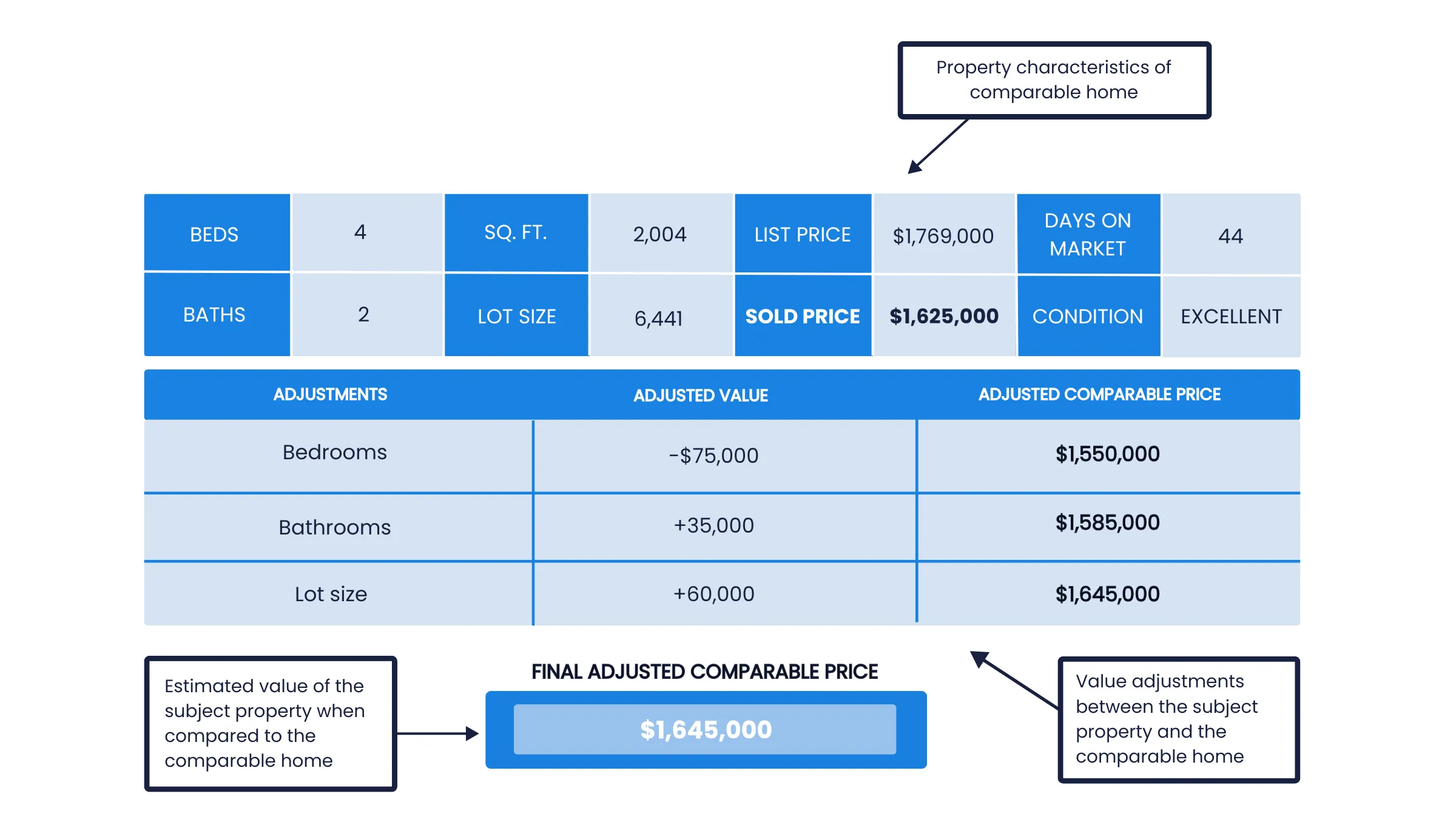
How does my home compare to each comp?
They should explain the price adjustments between those homes and yours.
If one comp sold for $X and their suggested price is higher, they should tell you why.
Common adjustments that impact the selling price of a home include:
- Square footage
- Condition
- Beds/baths
- Lot size
- Schools
- Location issues (like road noise).
Here’s an example of what that comparison can look like:
The way an agent answers this question will help you determine whether:
- They can defend the price when negotiating
- They are inflating the number just to win your listing.
And don’t help them reverse-engineer their price.
Holding back what you think your home is worth is one of the things you should avoid telling your listing agent.
2. In what percentage of your sales did you act as a dual agent?
In my experience, this is the one question you need to ask.
Why?
Because the way a seller’s agent answers is a strong indicator of whether they’ll look out for your best interests.
An agent earns two commissions if they represent both the seller and the buyer in the same transaction.
You can probably see where this is headed.
Pay attention to their body language.
If they get vague, look uneasy, or start backpedaling, don’t ignore it.
Some listing agents are willing to risk their integrity to engage in dual agency.
By “risk their integrity,” I mean:
- Push you to accept an offer that favors their buyer
- Limit the marketing of your home, without you knowing
- Not present all offers to you
- Minimize their negotiating with buyer agents so their buyer “wins.”
I saw this many times when I was a Realtor and represented a buyer.
And in most cases, the home sells for a far lower price than it would have if the agent had been only representing the seller.
The agents who have a higher-than-average number of dual agent sales are the agents who prioritize a higher commission above their clients’ best interests.
That’s why this question is so important.
And it’s why we treat this as a deal-breaker when matching sellers with top agents.
In most markets, an acceptable dual agency rate is 10% or less (it can run a bit higher in some lower-priced areas).
That’s the benchmark.
If an agent answers with anything higher than that, I wouldn’t hire them.
3. How will you vet the buyer?
Failing to vet a buyer is a common reason for a house going back on the market.
That usually happens because the buyer wasn’t truly qualified.
The seller accepts their offer with a financing contingency.
But then the loan falls apart.
Asking this question shows you how the agent will reduce the odds of that happening.
At a minimum, they should:
- Require a pre-approval letter with every offer
- Call the buyer’s lender before you accept an offer.
But they should go deeper.
For example, do they ask the buyer’s loan officer:
- What’s the source of the down payment?
- What’s the buyer’s debt-to-income ratio?
This level of diligence matters.
Because debt-to-income issues are one of the most common reasons for buyers not getting a mortgage.
The agent’s answer can also reveal their negotiating expertise.
Here’s how…
Being at the lender’s debt-to-income limit is a common excuse buyer’s agents use to say their client can’t go higher.
So if the agent verifies the buyer isn’t at their maximum, they can call the bluff and negotiate harder.
That’s why you need to understand how an agent vets a buyer before you hire them.
4. How will you market my home?
Any agent can put your home on the MLS and stick a “For Sale” sign in the yard.
That’s not a marketing plan.
What you’re really trying to learn is whether the agent has an actual strategy.
A good answer should include three parts.
Your selling features
An exceptional agent knows how to highlight a home’s best features.
Every home has at least one.
For example, if your house needs updating, the selling features might be:
- A lower price compared to nearby listings, which can mean lower monthly payments and property taxes
- The chance for a buyer to add their “own artistic touch.”
An agent will most likely market your home like every other listing if they can’t articulate the “hook.”
Your target buyer
This is where an average agent will be vague.
A top agent will describe a likely buyer profile based on your home’s location, price point, condition, and lifestyle fit.
And then they’ll explain how that affects their pricing and marketing strategy.
They don’t need to be perfect.
But they should be thoughtful and specific.
Maximizing demand for your home
Most agents will mention the basics when you ask how they’ll find buyers for your home.
MLS exposure, syndication to major real estate sites, professional photos, and an open house.
But those are table stakes.
What you want to hear is how they’ll bring the pieces together.
For example:
- How they’ll stage and photograph the home to highlight the selling features they just described
- How they’ll reach buyers and their agents through various marketing channels (agent network, targeted online marketing, local outreach)
- How they’ll measure interest and adjust quickly if showings and offers aren’t tracking to plan.
This should sound like a plan tailored to your home with a goal of driving multiple offers.
So consider it a red flag if their answer is basically “MLS + Zillow.”
5. How should I prepare my house before selling?
This question is important because it shows two things fast.
How well the agent understands which prep work will actually add value to your home.
And whether they can tailor advice to your situation.
An agent shouldn’t jump straight into a random checklist during your first meeting.
They should clarify your goals first.
For example, do you have the budget and time to make improvements that will maximize your sale price?
Then the agent’s answer should include upgrades that offer a strong return on your investment.
Do you plan on listing soon and want to keep things minimal?
Their response should highlight quick, high-impact changes that maximize your home’s appeal.
Or is your plan to sell your home as-is?
Then they should have simple ways to make your home look more presentable so you don’t scare off the best buyers.
Most agents have reliable pros they can recommend.
And some can make the process of getting your home ready to sell a lot easier by coordinating the work.
But what matters most is whether their advice fits what you’re trying to accomplish.
The right seller’s agent will tailor a plan around your goals.
The wrong one will push a long list of upgrades before they even ask a question.
6. What’s your listing fee, and how does the commission work?
The real estate commission works a bit differently now than it has in the past.
There’s more transparency and more negotiation than most sellers expect.
So the agent should be very clear about how it works and what they charge.
Here’s what you want their answer to cover.
The agent’s listing fee
The agent should state what their commission rate is and what that fee covers.
And they should confirm it will match what will be written in your listing agreement.
Ask for a seller net sheet (estimated settlement statement) so you can see how their listing fee impacts your estimated net proceeds.
That will show the agent’s commission, typical closing costs, and your likely net proceeds.
Now here’s the important part.
Don’t make paying the lowest commission your top priority.
Many low-fee agents either lack experience or run a high-volume model that won’t give you the effort you need.
But you also want to make sure the agent has what it takes to negotiate for you.
So ask this follow-up question.
Is your commission flexible?
The right agent will explain why they’re worth their commission and what would change if the fee changed.
The answer you don’t want to hear is an immediate “yes” with no explanation.
I’d consider that a red flag.
Why?
Because if that Realtor doesn’t defend their financial interest, it’s highly likely that they won’t defend yours.
How the buyer’s agent gets paid now
Sellers used to see commission as one total number.
Part of that was buyer agent compensation, which was offered through the multiple listing service.
Now, offers of broker compensation can’t be communicated in the MLS.
But that doesn’t mean the commission for the buyer’s agent disappears.
It means compensation is now negotiated in the offer, and the seller can negotiate it just like price and other terms.
The agent should clearly explain this to you.
7. How many homes have you sold in my area as the listing agent?
Many sellers ask this because they think it’s a requirement.
It isn’t.
Today, buyers can learn a lot about a neighborhood online.
So “knowing the area” isn’t the same thing as knowing how to sell in it.
But this question is still important, because it reveals something more than neighborhood trivia.
It tells you whether the agent has relevant selling experience.
That matters, because you want an agent who has sold similar homes to yours in your area and price range.
Make sure they answer the right question.
Their number should reflect homes they sold as the listing agent, not homes they helped buyers purchase.
Then ask for proof.
A good agent will quickly reference recently sold listings in your area and explain their selling strategy.
How they priced them, how they created demand, and what happened during negotiations.
That’s the real value of “local experience.”
And an agent with recent experience nearby is more likely to understand whether you’re in a seller’s market or a buyer’s market.
That’s key because your local real estate market impacts your entire selling strategy.
8. Can I cancel the listing agreement?
This is the second most important question to ask a real estate agent.
Here’s why…
The listing agreement is a binding contract.
In most cases, it’s exclusive, meaning you can’t just switch agents a week later because you’re unhappy.
And many agreements run 3 to 6 months.
So if you commit to the wrong listing agent, you’re stuck.
This means your agent has the potential to earn a commission regardless of whether you’re satisfied with their services.
I’ve seen this firsthand.
A seller is frustrated because the agent isn’t following through.
And they can’t switch unless they pay a commission to get released.
That’s why some agents will tell you exactly what you want to hear before selling your home.
For example:
- Unrealistic sale price: They promise to sell your home for a price they can’t justify just to get you to hire them.
- Guaranteed quick sale: They claim they can sell faster than anyone else, but in reality they don’t have a strategy.
- Great “interview energy,” poor follow-through: They seem responsive up front, then communication drops off after you sign the agreement.
There is absolutely no reason why you should be locked into a contract.
Even if you never want to cancel, having the option to do so means the agent’s commission check is not “guaranteed.”
And that means your agent will be more motivated to sell your house quickly and for a price that you’re happy with.
That’s why having the freedom to opt out of the agent contract is one of the most important things to know before signing a listing agreement.
How important?
If the agent doesn’t quickly answer this question with “yes,” then you shouldn’t hire them.
9. What’s your sale-to-list price ratio?
Any Realtor can tell you the sale prices of the homes they’ve sold.
This question goes one level deeper.
It clues you in to whether the agent has a history of over- or underpricing the homes they list.
In real estate, this is called sale-to-list price ratio (also called sold-to-list).
It’s the sale price divided by the original list price.
For example, if a home sells for $1,000,000 after being listed at $950,000, the sale-to-list price ratio is about 105%.
Be cautious if an agent’s answer is significantly higher or lower than 100%.
Here’s why…
A high ratio can mean the agent tends to underprice to drive urgency and create a bidding war.
But some agents do this to market themselves with postcards like, “Just sold for $$$ over asking price!”
The listing agents who underprice aggressively typically have a sale-to-list price ratio of 110% or higher.
On the other end, a ratio under 100% can mean the agent has a history of overpricing and chasing the market with price reductions.
That usually comes from inexperience, or from overpromising a sale price to win the listing.
From my experience, anything under 95% is a major red flag for how an agent prices and negotiates.
Most agents will explain why their percentage is what it is.
So pay close attention to how the agent communicates their answer to you.
Because the way they defend that number tells you how they will defend your price to buyers.
10. What’s your average days on market (DOM)?
Asking this question can give you insight into how efficiently an agent sells their listings.
Days on market (DOM) is the time from when a home hits the MLS to when it goes under contract (when an offer is accepted), not when the sale closes.
But DOM isn’t a standalone score.
It can swing based on property type, location, condition, seasonality, and how much buyer demand exists at your price point.
Here’s how to use it the right way.
Ask for their average DOM on seller-side listings over the last 12 months.
And ask for the number in your area and price range.
Then listen to how they explain it.
A higher-than-average days on market for your area usually means the agent overprices or doesn’t execute the right selling strategy.
And a much lower DOM typically means the agent lists homes under market value or they’ve been selling in a hot segment of the market.
Then ask this follow-up question:
How do you balance getting top dollar with keeping days on market low?
The right agent will connect their pricing and marketing strategies to buyer demand in your local market.
They should also tell you what “good” looks like in the first 10 to 14 days on the MLS.
And exactly when they might suggest a price reduction if the days on market is higher than expected.
11. How often will you update me during the selling process?
Knowing how often you’ll hear from your agent is key.
Because not every real estate transaction is smooth sailing.
Ask if they have a set cadence for communication.
Will it be every few days? Weekly?
After every showing and open house?
The best answer isn’t just “whenever you want.”
It’s a clear default plan, plus flexibility if you want more.
What you don’t want is an agent who goes quiet once your listing is live, or only calls when there’s a problem.
Because a lack of communication is one of the warning signs of a bad Realtor.
Clear and consistent outreach is what you want from your agent.
And confirm how you’ll communicate.
Text, phone, or email.
You want to be on the same page before you hire them.
The final word
The questions you ask a Realtor when selling your house are important.
It’s your chance to make sure your agent will protect your interests and deliver the best result.
But it’s understandable if you don’t love the idea of interviewing agents like it’s a job interview.
A big part of our vetting process is asking many of these questions up front so you don’t have to start from scratch.
Our no-cost agent matching can connect you with a top local listing agent.
We can also give unbiased feedback on an agent you’ve talked to.
We prioritize agents who:
- Have experience selling homes in your area and price range
- Earn top-rated reviews from sellers
- Maintain a lower-than-average history of dual agency
- Offer a listing agreement you can cancel if needed.
Remember, it’s not just about knowing which questions to ask.
It’s about getting the right answers.